Continued from “Learning to Ride In the Wind "” Real Wind“
Since this is the first year that we don’t have a car, we have had to learn how to pack things home, and have had quite a few mishaps along the way.
I knew that without studded tires, I had to walk over the flooded areas that spilled over onto the trail and froze. However, I had forgotten how far down the trail these areas went and ended up riding on the ice in the dark.

I fell. The impact broke the zip ties on my crate which in turn went flying off as I landed on my knees. I got up, put the loose items in my backpack and strapped the crate back on with bungees.
But this didn’t work well. The bungees somehow ended up wrapped around both sides of my bike chain. This turned into a finger-freezing moment as I tried to untangle the mess and mentally added a knife to my mandatory pack list.
Sometimes you’ve got to just cut things loose. I became afraid that I would fail this commute-by-bike challenge as I struggled on the trail in the dark, subzero weather. But I kept at it and the bungees finally came out.
I turn on my music and turn it up. I start walking, with a little limp, giving myself permission to relax and de-stress from the situation. I had time. The snow was bright. I got to work early.
Packing and Securing my Load
My bike is equipped with one back rack. So I end up piling all of my things high onto the back wheel. This presents a problem for me when riding in high winds. I have had to take my load back to my office and leave it there because it is too windy to make it home safely with everything piled so tall on the back.
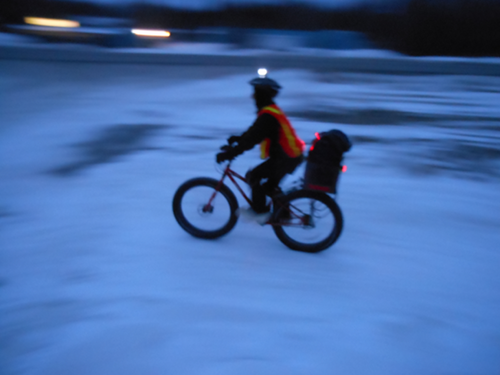
A front rack and a way to distribute weight evenly is on our list of must-haves.
However, we have found that as we change from driving a car to biking, sometimes it takes time and experimenting to determine what you need and how to get things set-up right.
What really seems like a good idea is to actually weld a front and back rack to the bike frame so it is all just part of the bike. However, for now we avoid shopping and having to bring groceries and other supplies home when wind is in the forecast.
We have found that having a little bit of a stockpile at home is important for this reason, again considering that we cannot control the weather.
Air Pressure
When the first real snow fell this winter, I rushed out in great excitement and jumped on my Pugsley. I hit the trail, the bright white snow was beautiful and made everything quiet and peaceful as I headed to work, a smile pasted on my face.
However, not far down the trail did I find a new lesson waiting. As I hit the four-wheeler trail, I slipped into a rut and flew off my bike!

In fact, I went flying multiple times on my way to work, making me concerned that I would not be able to keep up this commute-by-bike. I was afraid of injuring myself. It was a rough and scary ride to work, trying to keep on my bike seat.
After work I went over to the Alaska Bicycle Center to see if the chains were in. Not yet.
Richard asked me about the air pressure in my tires. I didn’t know at what what pressure my tires had been set. He let air out. They were at 20 PSI, great for a summer ride on paved trail; this was not summer anymore! He put them at 11 PSI.
He said letting air out will give the tires more grip. On my trip home, I was still worried about falling and injuring myself. My fingers were wrapped tightly around the grips, shoulders tense, watching my front wheel that fit just inside the four-wheeler tracks waiting for an inevitable slip.
I rode through the bumps and the hills. When I got to a pile of snow, I would stand up and lean forward. I had more power and I didn't slip. I was relaxed. My tires were “gripping” and I began looking around me and enjoying the beautiful snow.
My commute was again possible and, as I thought about it, I seemed to remember reading something about “grip” on this Website, but had forgotten about it until today.
My Feet Get Me There Too
As part of our plan to commute by bike thru the winter, we bought chains for the fat bikes. We paid for them in advance because this was such an essential part of our winter transportation needs. In Alaska, studs or chains were essential when I drove a car and since my bike is my vehicle, this was still a requirement.

Our routes pass over flooded and frozen over areas as well as waterways. We can also get freezing rain in the winter. Without chains or studs, we have to walk certain stretches of the trail. This means that I take longer to get to and from work.
The chains came in. Richard has spent time putting chains on a fat bike at the shop. He says the chains aren't a perfect fit, and while there may be some way to make them work, they are not a perfect fit.
So we changed to studded tires.
Although this is difficulty that I didn’t plan on, I purchased knee pads and cleats and we are doing a lot of walking. Things don’t always work out as we plan. I still get where I need to go. By making myself get out and do it, I learn.

The world is beautiful. I have time to enjoy the stars. I am learning the routes I can take so when I do get studs and/or chains, I will be able to ride my bike.
My feet get me there too, just a little slower. I guess you could call that cross-training!
To be continued…
Shanna Ladd is a car-free bike commuter in Alaska's Matanuska-Susitna Valley (a.k.a. "The Mat-Su"), north of Anchorage.